Diogenes The Cynic: The War Against The World by Luis E. Navia
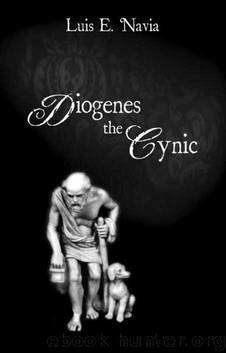
Author:Luis E. Navia [Navia, Luis E.]
Language: eng
Format: epub
ISBN: 9781591023203
n order to develop a fair and balanced assessment of Diogenes' Cynicism, several issues must be examined without assumptions or prejudices. First, a review of the sources must be undertaken and a biographical portrait of Diogenes must be attempted. Second, a review of the medium or rhetoric of Cynicism as he exemplified it must be conducted. Third, an explanation of the circumstances responsible for his transformation into a Cynic-his Cynic metamorphosis-must be constructed. The preceding three chapters have endeavored to accomplish these tasks, hopefully with some success.
However, unless yet another task, perhaps the most important, is attempted, Diogenes as a philosopher would remain only a blurry ghost of ancient times-interesting and amusing, bizarre and peculiar-but not much more. The fourth issue that will occupy us in this chapter can be expressed in the form of several questions. Was there an intellectual basis for what he said and did and for the strange life he lived? Were there thoughts, ideas, convictions, principles, and concepts that animated the expressions of his Cynicism? Are we justified in speaking about the philosophy of Cynicism? Was Diogenes just a performer in whom clear thoughts had no shelter?
It is not surprising that these questions have been answered in all sorts of ways. Cynicism often evokes strong responses from those who are acquainted with it. They range from enthusiastic approbation and admiration to absolute contempt and emphatic rejection. For some, Diogenes was and is the ultimate reality check, the man who truly knew and understood the problem of human existence, the philosopher whose presence, were he resurrected in the twenty-first century, could teach us to see things precisely as they are, and who could help us build the bridge between the way they are and the way they ought to be. For others, more numerous, he was a pseudophilosopher, a sort of buffoon who rejected things he did not understand, and could be kept in memory only as an aberration, an anomaly of bad taste, in reality a man of little mind. His Cynicism, from this point of view, amounts to nothing of value. What truth lies in these responses?
In his account of Cynicism, Hegel notes that "there is nothing particular to say about the Cynics, for they possessed but little philosophy, and did not bring what they had into a scientific system." He condudes that the Cynics were,
Download
This site does not store any files on its server. We only index and link to content provided by other sites. Please contact the content providers to delete copyright contents if any and email us, we'll remove relevant links or contents immediately.
The remains of the day by Kazuo Ishiguro(9089)
Tools of Titans by Timothy Ferriss(8494)
Giovanni's Room by James Baldwin(7440)
The Black Swan by Nassim Nicholas Taleb(7198)
Inner Engineering: A Yogi's Guide to Joy by Sadhguru(6837)
The Way of Zen by Alan W. Watts(6673)
The Power of Now: A Guide to Spiritual Enlightenment by Eckhart Tolle(5855)
Asking the Right Questions: A Guide to Critical Thinking by M. Neil Browne & Stuart M. Keeley(5834)
The Six Wives Of Henry VIII (WOMEN IN HISTORY) by Fraser Antonia(5559)
Astrophysics for People in a Hurry by Neil DeGrasse Tyson(5226)
Housekeeping by Marilynne Robinson(4505)
Double Down (Diary of a Wimpy Kid Book 11) by Jeff Kinney(4338)
12 Rules for Life by Jordan B. Peterson(4331)
Ikigai by Héctor García & Francesc Miralles(4312)
The Ethical Slut by Janet W. Hardy(4310)
Skin in the Game by Nassim Nicholas Taleb(4308)
The Art of Happiness by The Dalai Lama(4170)
Skin in the Game: Hidden Asymmetries in Daily Life by Nassim Nicholas Taleb(4052)
Walking by Henry David Thoreau(4002)
